Prepare young children for greetings, a family meal and saying thank you with a little practice and plenty of adult support.
Your child may be excited to see a cousin and worried about the crowded dining room. They may love the decorations and dislike almost everything on their plate. Thanksgiving can ask a great deal of a small person before the meal has even begun.
Teaching Thanksgiving manners for kids starts with making the day understandable. Explain what will happen, practice one useful phrase and stay close when your child needs help. A family gathering does not need to become a test of everything they have learned.
Choose one thing to practice before the visit
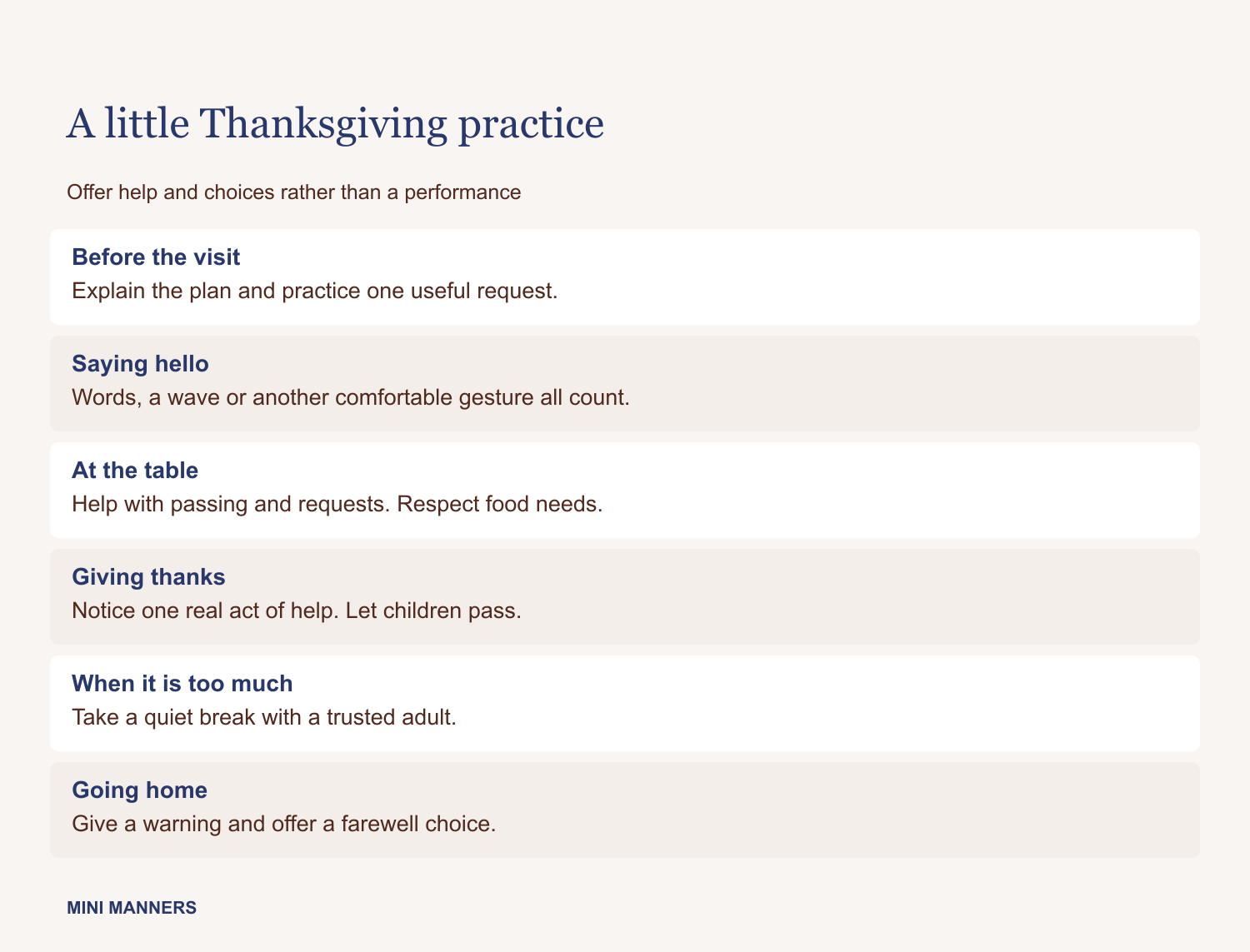
Pick a small skill that would help your child at this particular gathering. Perhaps they need a way to ask for water or tell you they need the bathroom. Rehearse it while you are both comfortable, not in the car as a final warning.
Use two toys and a pretend table. One toy asks, "Could I have some water, please?" The other passes an empty cup. Let your child switch roles or answer with a gesture. Keep the practice short enough that it still feels like play.
Describe the plan in a few concrete steps: "We will say hello, play for a while, eat and then go home." Mention anything that will be unfamiliar, such as a dog, a different bathroom or a long table. Be honest if you do not know when dinner will be ready.
Give greetings a comfortable starting point
A relative your child met last year may feel like a stranger now. Make the introduction yourself: "This is Aunt Rosa. She is happy to see you." Let your child stay beside you while they settle in.
Offer a greeting choice: words, a wave or another familiar gesture. A child does not need to make eye contact, shake hands, hug or kiss to be welcoming. You can say to the adult, "We're saying hello with a wave today," without asking your child to defend that choice.
If your child says nothing, model the greeting and move on. Avoid labels such as "She's our shy one." ZERO TO THREE's guidance on children who take time to warm up encourages adults to allow time and respect different ways of being social.
Make the meal manageable
Ask the host about the likely mealtime and bring any familiar food or suitable snack you have agreed on. Tell the host privately about allergies or other essential food needs in advance. Adults should handle those arrangements; a young child should not have to explain them to everyone at the table.
Help your child find a comfortable seat and show them where their cup and napkin are. Give a practical reminder when it is needed: "The bowl is hot. I'll pass it." Keep serving dishes, sharp utensils and drinks out of reach when appropriate.
Do not turn trying a new food into the price of being polite. A simple "No, thank you" can decline an offer. If a relative insists, step in: "Thank you for offering. We have their food covered." Keep comments about bodies and amounts eaten out of the conversation.
For more meal planning ideas, the American Academy of Pediatrics has a Thanksgiving guide for picky eaters. Follow your child's established care plan where food needs are more complex.
Help children join the conversation
An open question such as "What have you been doing lately?" can feel enormous. Offer a smaller bridge: "Would you like to tell Grandpa about the tower, or shall I start?" Accept a short answer and allow your child to listen.
Prepare a useful interruption phrase, such as "Excuse me, I need help." Explain that adults may need a moment to finish speaking, but urgent needs can be brought to you immediately. Do not ask a preschooler to judge how long every adult conversation should take.
If the table is noisy, move closer rather than asking your child to speak louder repeatedly. A quieter conversation with one relative later may work better than a question announced across the whole room.
Offer a small helping job
Children can feel included when they have something real to do. Offer two safe choices: put paper napkins at the places or choose a book to share with a younger cousin. An adult remains responsible for the meal and the children.
Choose a job they can stop without disrupting dinner. Carrying hot plates, supervising another child or managing a pet is not a preschooler's responsibility. If they decline, find another way for them to be involved instead of calling them unhelpful.
Notice the specific action afterward: "You put a napkin by each plate. That helped us get ready." You do not need to announce their contribution to the entire room.
Make gratitude specific and optional to share
Young children may find it easier to notice a real moment than name everything they are grateful for. Try, "Who helped us get here today?" or "What did you enjoy doing with your cousin?" You can offer your own answer first.
A family gratitude round should allow a child to pass, draw an answer or tell a trusted adult quietly. Being tired, missing someone or feeling disappointed does not cancel appreciation. You can say, "You miss your friend, and you liked playing with Leo. Both can be true."
Our Family Gratitude Practice Pack offers space to notice everyday helpers, talk about mixed feelings and share a family moment. Use only the pages that suit your child; there is no need to complete the pack during the gathering.
Watch a Thanksgiving episode and try one thing
Watch How Kids Learn Gratitude and Polite Greetings together before the visit. After the gratitude conversation, pause and ask, "Who helped us with something today?" Then try thanking that person in words, a drawing or another comfortable way.
The episode also demonstrates greetings. Adapt those examples to your child: looking toward someone or choosing a wave can be enough. Treat watching as a starting point for a conversation, not a lesson your child must reproduce perfectly at dinner.
Plan a break and a calm goodbye
Agree on a quiet place with the host and stay with your child when they need a pause. Offer the break before every sign of tiredness becomes a struggle. Returning to the gathering is easier when stepping away is not treated as punishment.
Give a simple warning before leaving: "One more picture, then we will get our coats." Help your child choose a farewell and thank the host yourself. Later, mention one moment that went well and ask what would make the next visit easier. That is useful practice for the next gathering, too.