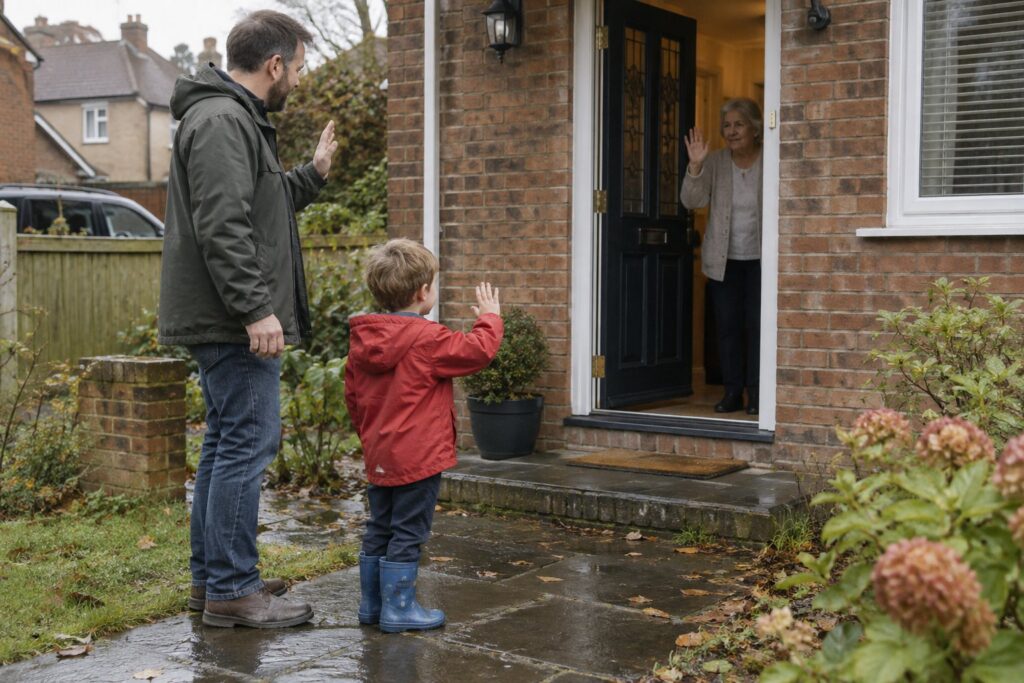
Your neighbor says hello. Your child steps behind your leg. Suddenly, a perfectly ordinary greeting feels like a public test of your parenting.
You might be tempted to fill the silence with “Say hello!” or explain that your child is shy. Instead, greet the neighbor yourself and give your child a moment. A wave, a small nod, a spoken hello, or a greeting on a communication device can all acknowledge someone.
When you're teaching a child how to greet adults, it helps to have a few choices ready. You can practice those choices at home, support them at the door, and let a brief greeting be enough.
Decide what a greeting needs to do
A greeting lets another person know you've noticed them. It doesn't have to include a conversation, a hug, or direct eye contact.
Think about the hellos you use yourself. You might wave across a parking lot, smile at someone carrying groceries, or say a quick “Morning” while getting your keys out. Children can have more than one version, too.
Choose something your child can comfortably manage. If waving is difficult, they might turn toward the visitor or use a familiar gesture. Ask an older preschooler, “How would you like to say hello today?” For a younger child, offer just two choices.
Practice before someone is waiting
The doorstep can be a busy place. There are coats, bags, excited voices, and an adult your child may not remember well.
Before a visit, explain who's coming and what will happen. Keep it specific: “Aunt Rosa is coming for lunch. I'll open the door. You can stand beside me and wave if you want.”
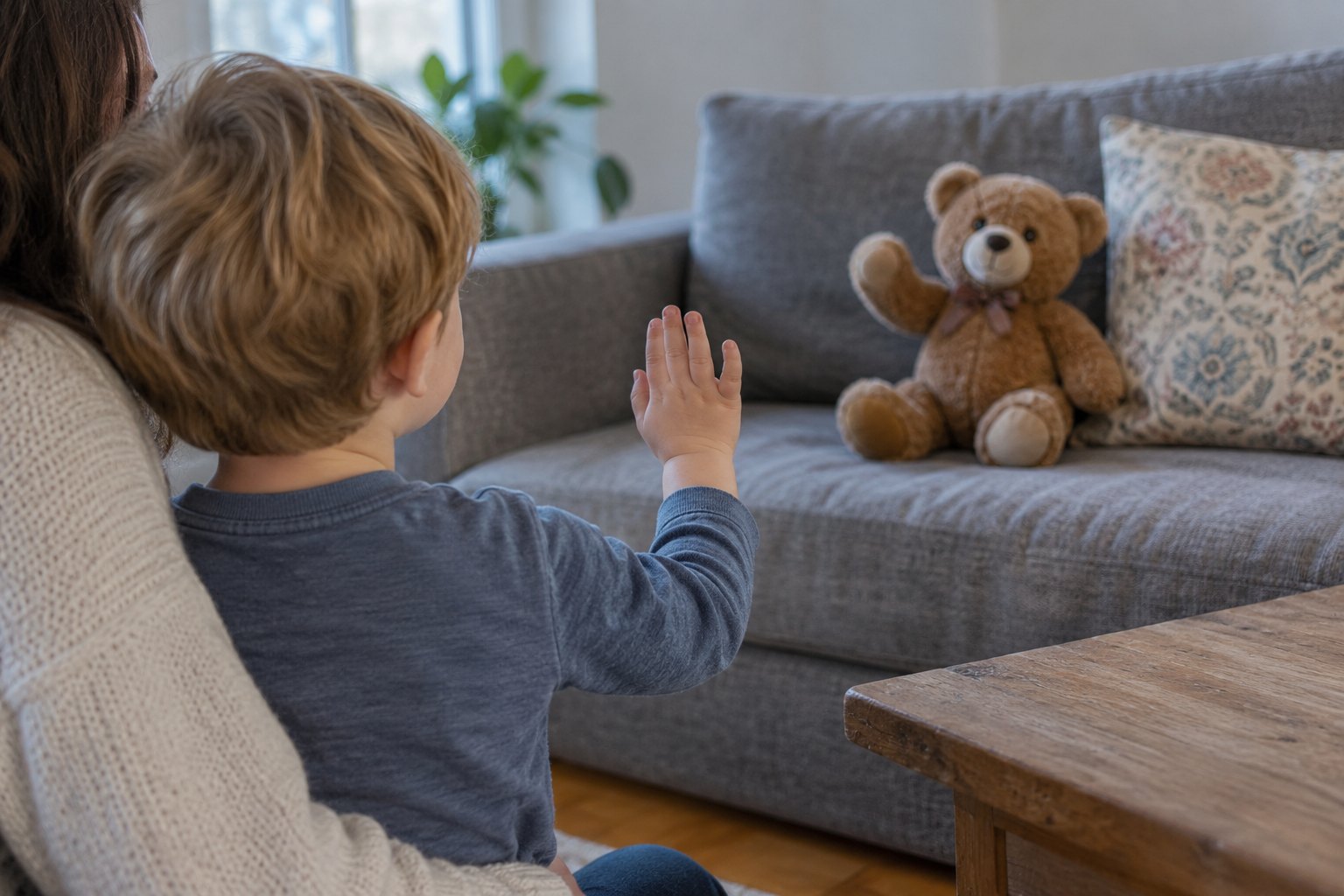
If your child enjoys pretending, take turns knocking on a bedroom door. One person arrives, the other answers. Practice a wave, then swap roles. Let your child be the grown-up who welcomes a stuffed animal.
Stop while it's still fun. There's no need to repeat the greeting until it sounds polished or to require a louder voice. Your child can rehearse quietly and still choose something different when the visitor arrives.
Offer a small menu of hellos
Try two or three options together:
- Say “Hi” or “Hello.”
- Wave from beside your parent.
- Give a nod or another familiar gesture.
- Use a greeting button, sign, or communication device.
A child who likes talking might add the person's name. That can be a later addition, rather than an extra requirement at every introduction.
Avoid attaching a reward to one particular response. If you've offered a wave as an acceptable choice, accept it as warmly as spoken words. You can simply wave back and continue the visit.
Be the first person to say hello
Show your child what you mean without directing all the attention toward them.
“Hello, Mr. Lee. It's nice to see you.” Then pause briefly. Your child might join in, or they may need you to carry the greeting this time.
If they stay close, you can say, “We're happy to see you,” and move on. Avoid narrating their personality in front of them: “She's so shy,” “He never talks,” or “She was chatting all the way here!”
Our guide to how children learn by watching you has more examples of everyday modeling. You don't have to give a lesson each time. Let your child hear you greet the librarian, a friend, and the person delivering a package.
Keep affection optional
Saying hello doesn't create an obligation to hug, kiss, shake hands, or sit on someone's lap. A child can enjoy a relative's company and still want physical space.
The National Sexual Violence Resource Center's guidance on communicating with children advises adults to accept a child's refusal of physical affection, including with relatives. A child shouldn't have to manage an adult's disappointment about a hug.
You can help with a calm sentence: “We're letting her choose about hugs. You can say hello from there.” If someone keeps asking, step in rather than waiting for your child to defend the decision again.
For more language to practice together, read our guide to helping your child say no politely. Their boundary still matters if they can't find a polite phrase in the moment.
What if your child won't greet anyone?
Start by taking the pressure out of that encounter. Greet the person yourself, keep your child close if they want, and get on with what you came to do.
Later, you can ask a simple question: “Was the doorway too busy?” or “Would you like me to say hello with you next time?” Accept a shrug. You don't need a full explanation to make the next arrival easier.
Try arriving before a gathering gets crowded, meeting one familiar person at a time, or giving your child a useful job, such as carrying their own coat. These are options to experiment with, not steps they must complete before they're allowed to join in.
Don't assume silence is deliberate rudeness. If communication feels persistently difficult or distressing, discuss your concerns with someone who knows your child, such as their teacher or pediatrician.
Help other adults make room
A short message before a family visit can spare everyone an awkward exchange: “We're practicing greetings with choices. Please give him a moment and don't insist on a hug.”
Ask visitors to avoid a stream of questions as soon as they arrive. “Hello, I'm glad to see you” leaves more room than asking about school, friends, and favorite colors before the coat is off.
You can also move the greeting into an ordinary activity. Sit down with a puzzle or show the visitor where to put their bag. Your child may find it easier to join once the attention has shifted.
Practice together: choose a hello
Use our My Hello Choices practice card to draw or choose two greetings. Try them with a toy, then put the card near the door if your child would find that helpful.
Before your next visit, remind them of their choices once. Afterward, notice something specific if it feels natural: “You waved when Grandma came in.” Skip the scorecard and the replay of everything they could have done differently.
There will be more people to greet tomorrow. For now, help your child arrive, feel welcome, and find a way to acknowledge someone that works for them.
Further reading
Practice it together
One printable page to keep the ideas close at hand.