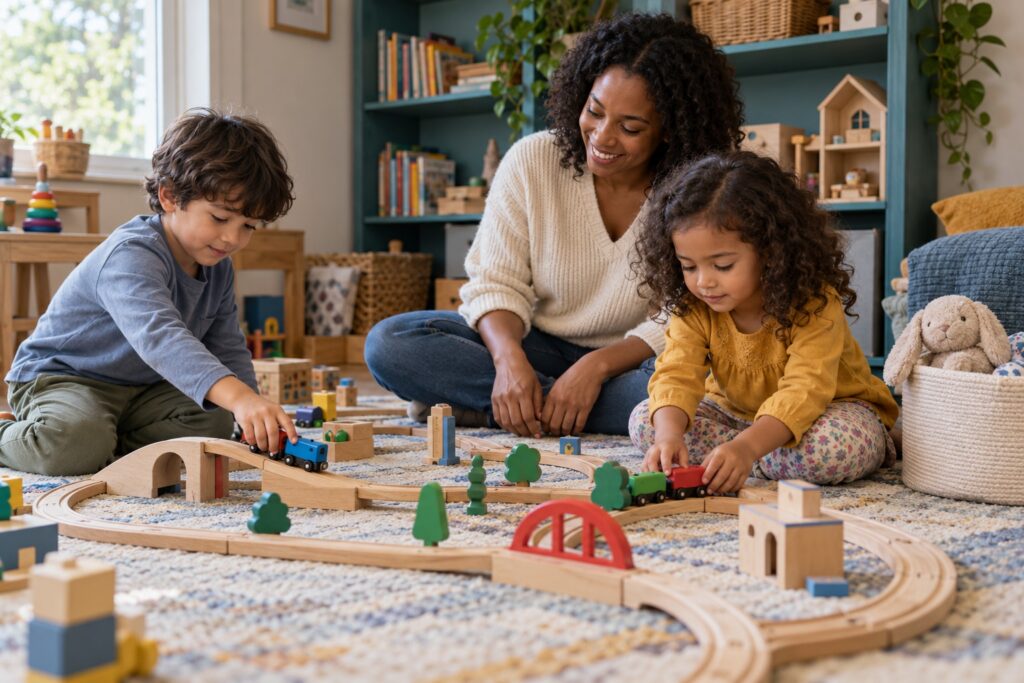
Make shared play easier with a clear turn plan, something to do while waiting, and room for personal belongings to stay personal.
One child is building a road. Another reaches for the only red truck. You hear “Share!” come out of your mouth before you have decided what sharing should mean this time.
Does the truck belong to one child? Is it a shared toy? Has someone just started playing, or is everyone waiting for a turn on playground equipment? Those details change the help children need.
Teaching turn-taking does not require your child to hand over every possession whenever someone asks. It means helping children understand a fair plan for the things they use together. You can make that plan clear, support the waiting, and step in when feelings get bigger than the children can manage alone.
Mini Manners · Practice together
Our Turn-Taking Plan
Choose one shared toy. Let an adult help everyone understand the plan.
- Name the toy. Is it a personal belonging or something we are using together?
- Make the turn clear. Choose one small finishing point and say who has the next turn.
- Choose while waiting. Pick a different activity. Ask an adult to help remember the next turn.
Words to try
“Can I have a turn when you’re finished?”
“You can finish this trip, then I will help with the next turn.”
“Would you like to build or read while you wait?”
Try it: Draw the shared toy and something you could do while you wait.
Personal belongings can stay personal. Adults manage safety, equipment rules and turn agreements; a timer is optional.
First, name what kind of toy it is
A favorite stuffed animal, a newly opened present, and the climbing frame at the park do not need the same rule.
Before a playdate, help your child choose a few personal belongings to put away. Say, “These can stay on your shelf. The blocks in this basket are for playing together.” Do not offer another child a private toy your child has not agreed to lend.
For a shared supply, be equally clear: “These markers are for everyone. Maya is using the red one now. Let's ask about a turn.” A shared item needs a workable arrangement, not a contest over who can hold it longest.
If the question is permission to use someone else's property, our guide to asking before borrowing covers that separate conversation.
Describe the next turn in something children can see
“Soon” and “in a minute” can leave everybody guessing. Look for a natural finishing point instead: one trip down the slide, the end of a short song, or finishing the car's journey to the garage.
Try, “You can drive it along this road, then Sam will have a turn.” Check that the child understands the plan before you announce it as settled. For shared equipment with posted rules, follow those rules rather than inventing a different arrangement.
Sometimes a simple timer helps. Use it as a reminder of an agreement, not a surprise announcement that a toy must be surrendered. You still need to support the handover if your child finds it hard.
ZERO TO THREE's guidance on sharing suggests helping one child finish playing while helping the waiting child find another activity. That is a useful starting point for many shared-toy moments, not a rule that overrides safety or a group's equipment policy.
Help your child ask without promising a yes
Offer words that fit the situation:
- “Can I have a turn when you're finished?”
- “Can we make a plan for the truck?”
- “I'd like the next turn, please.”
A younger child may point or use a shorter phrase while you help. There is no need to make them repeat a polished sentence before you assist.
If the toy is personal, the owner may say no. If it is a shared resource, help the children work out the order. Do not tell a child to “ask nicely” and then leave them without support when the answer is unclear.
You can also check whether they actually want the same thing. One child may want to drive the truck while the other wants to add it to a pretend shop. Two different jobs might let the play continue together, if both children want that arrangement.
Make waiting an activity, not a test
Standing beside a toy and watching every movement can make a wait feel longer. Offer a choice your child can actually use: “Would you like to build a garage or look at this book with me while you wait?”
Do not require them to look cheerful. “You really wanted it now” can acknowledge the disappointment while the plan stays in place.
Stay close enough to help. If you promised to support the next turn, remember who is waiting and return to the agreement. A child should not have to keep arguing to make an adult notice an earlier promise.
If your child chooses another game and no longer wants the turn, that is fine. Ask before interrupting their new play to deliver a toy they have stopped wanting.
When grabbing has already started
Move close and stop pulling or hitting: “I won't let you pull it out of her hands.” Help keep the children and the object safe before explaining the whole problem.
Then describe what you know without choosing a villain: “Nora was using the truck. You wanted a turn. We need a plan.” If you did not see what happened, say so and listen briefly to each child.
Avoid deciding that the child who cries first must get the toy, or that an older child must always give way. Return a taken personal belonging to its owner. For a shared item, rebuild a clear turn arrangement with adult help.
If the children cannot use an object safely right now, put it somewhere safe while you help them settle and choose what happens next. Explain the safety reason rather than using its removal to threaten better manners.
Practice the whole exchange when nobody is upset
Use one shared plaything and two toy characters. One character asks for a turn. The other finishes one small action. The first character chooses something else while waiting, then receives the next turn.
On another round, use a pretend personal belonging. Let its owner say, “Not this one.” Help the other character find a different activity. Showing both situations makes the distinction visible.
Switch roles if your child wants. They can be the adult who remembers whose turn comes next. Stop after a few minutes, before practice becomes another negotiation.
Watch, talk, then try one small plan
Watch the Mini Manners episode about patience, turn-taking and sharing together. Pause when something catches your child's attention and ask, “What could someone do while they wait?”
Then choose a small plan for your own shared play: one action, a clear next turn, and an alternative activity. Do not treat the story as a test your child must pass in the next disagreement.
Notice useful actions without keeping score: “You asked for the next turn, and we remembered the plan.” Children will need help again. The aim is a familiar, fair routine, with adults doing their share of the remembering.
Keep the practice card nearby
Use the one-page card if it helps. You can also try the activity without printing anything.