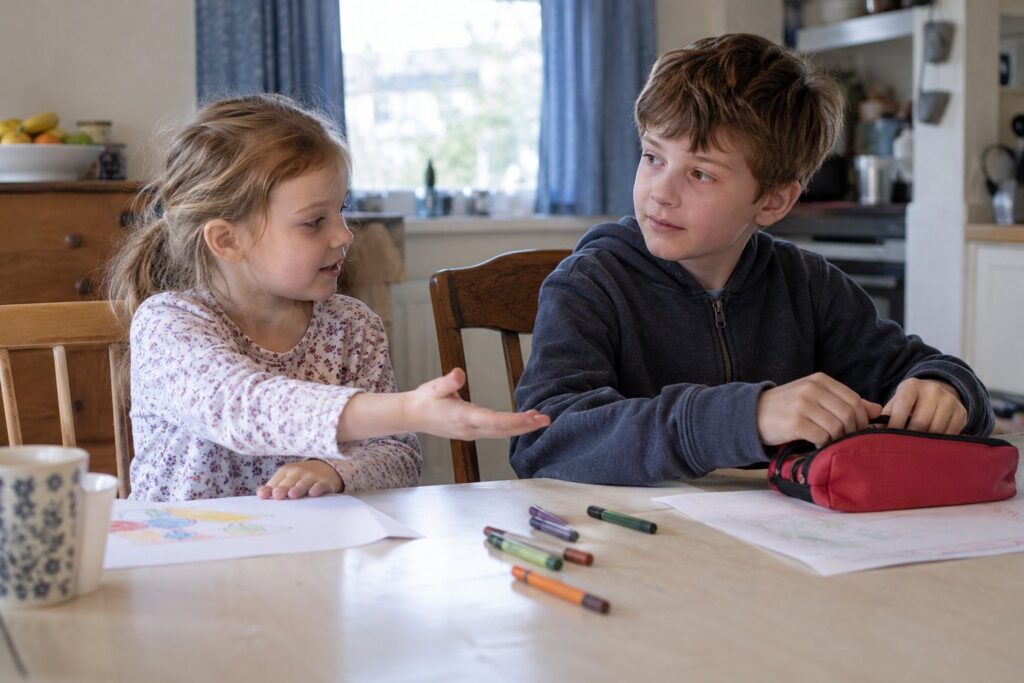
Your child spots a favorite marker on their sister's desk. It's right there, nobody is using it, and the picture they're drawing needs purple. To them, picking it up may seem perfectly reasonable.
Asking before borrowing takes a few separate steps: notice who owns something, ask, wait for an answer, then accept it. That's a lot to remember when a very interesting marker is within reach.
You can teach those steps in ordinary moments at home. Start with one short request and a clear rule: “Ask first, and wait for a yes.” Help your child practice with safe, inexpensive belongings when nobody is already upset.
Explain what borrowing means
Keep your explanation concrete: “Borrowing means someone lets you use their thing, and then you give it back.”
Show the whole exchange with a familiar object. Ask your partner to borrow a book, wait for the answer, use it briefly, and return it. Say where you're putting it so your child can see the ending.
Point out the difference between a family supply and a personal belonging. The crayons in the kitchen basket might be for everyone. The special pencils in a sibling's pencil case might need permission. A toy lying on the floor still belongs to someone, even if they've stepped away.
You don't need a rule for every object in the house. Begin with the things that cause regular arguments.
Give your child words they can use
Choose a phrase short enough for your child to manage:
- “Can I use that?”
- “May I borrow your truck?”
- “Can I look at your book with you?”
A younger child might say “Truck, please?” while you help with the rest. Pointing, signing, or using a communication device works, too. You can put the question into words without asking them to repeat it perfectly.
Practice the pause after the question. Your child can keep their hands beside them while the owner answers. If the person hasn't heard, help get their attention once. Silence isn't permission.
Try this yourself when you want something of your child's: “Can I borrow your green crayon?” Wait as you would want them to wait.
Make room for a real no
If asking always leads to an adult making the owner hand something over, the question stops being meaningful. A child can say no to lending a personal belonging.
Help the borrower with what happens next: “She wants to keep her notebook. You can use this paper, or we can look for your notebook.” Stay nearby if they're disappointed. You can acknowledge that feeling without reopening the request.
Sometimes the answer is “after I'm finished.” Check what that means, and help your child find something else to do. Avoid promising a turn the owner hasn't agreed to.
Our guide to helping children say no politely offers more language for setting a respectful boundary. You can practice hearing a no as well as saying one.
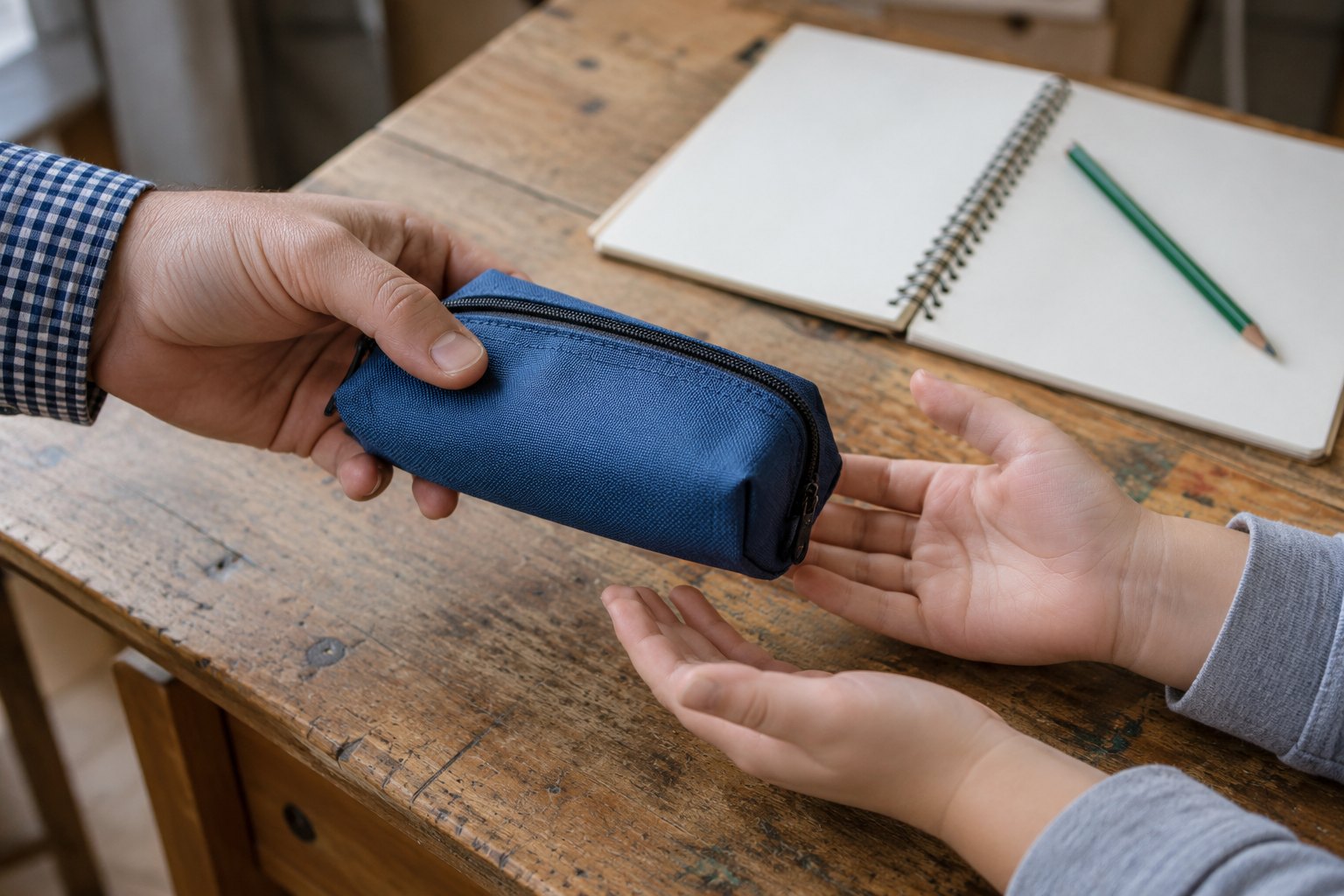
Separate personal belongings from shared supplies
Personal property and shared equipment need different rules. One child can keep a treasured stuffed animal to themselves. A classroom's only watering can needs a fair arrangement for everyone who uses it.
Tell your child which situation they're in: “Those are the park's toys. We'll follow the playground rules for turns.” At home, you might say, “These markers belong to everyone. Your brother is using that one, so let's ask when he'll be done.”
ZERO TO THREE recommends helping children through conflicts over toys, including giving a child time to finish playing and helping the waiting child find another activity. You can use that approach with shared materials while keeping permission rules for personal belongings clear.
For the wider question of communal toys and turns, see our guide to teaching sharing.
Agree on how the item will be used
Once the answer is yes, add one simple detail. “You can use the truck on the rug.” Or: “Please bring the book back when we leave.”
For an older preschooler, ask, “Where will you put it when you're finished?” Walk through the return together if needed. A familiar place, such as the owner's shelf, is easier to remember than a vague promise to return it later.
Ask again if the plan changes. Permission to look at a toy in a friend's home doesn't mean permission to take it home. Permission to use one sticker doesn't mean taking the whole sheet.
Adults still decide whether an item is safe to borrow. A child's yes doesn't make a sharp tool or a small choking hazard suitable for play.
When your child has already taken it
Step in calmly: “That's Leo's pencil case. We need to give it back.” Help with the return before discussing another turn.
Keep the explanation brief. “You wanted a pencil. Next time, ask Leo first.” Once everyone has settled, offer to practice the question with you. Avoid labels such as “thief” or a long speech in front of other children.
If something breaks, help your child tell you rather than hide it. You can work out an appropriate repair with the owner and their parent. An accidental break still deserves attention, but you don't need to turn it into a public lesson.
When the roles reverse, support your child's boundary, too. “That's yours, and you hadn't said yes. I'll help you get it back.”
Practice together: a two-minute borrowing game
Choose two safe objects, one for each of you. Take turns asking to borrow, answering, and returning them. Include a friendly no on one round so your child can try choosing something else.
Use the Ask, Wait, Return practice card as a reminder. Stop after a few turns, while the game still feels easy.
The next time your child pauses to ask, notice that specific action: “You waited for my answer before picking it up.” They'll need help again, and you'll have a familiar phrase ready.
Further reading
Practice it together
One printable page to keep the ideas close at hand.